AI in Orthopedic Surgery: How Machine Learning is Transforming Surgical Decision-Making

Artificial intelligence is no longer a futuristic concept in orthopedic surgery - it's a clinical tool that 40% of high-volume orthopedic practices are integrating into their workflows. From pre-operative planning that predicts implant sizing with 97% accuracy to postoperative algorithms that forecast complication risk within 48 hours of discharge, machine learning is reshaping how surgeons make decisions across the continuum of care.
Pre-Operative Planning: Where AI Has the Biggest Impact Today
The most mature application of AI in orthopedics is pre-operative templating and planning. Traditional templating involves overlaying implant templates on X-rays and manually sizing components. This process is subjective, time-consuming, and has historically achieved only 60-70% accuracy in predicting final implant size.
AI-powered planning systems have changed the game:
- Automated implant sizing: Machine learning models trained on thousands of cases predict final implant size with 95-97% accuracy, reducing OR time and inventory waste.
- 3D surgical simulation: AI generates patient-specific 3D models from 2D imaging, allowing surgeons to rehearse complex cases virtually.
- Optimal alignment calculation: Algorithms factor in patient anatomy, activity level, and implant biomechanics to recommend personalized alignment targets.
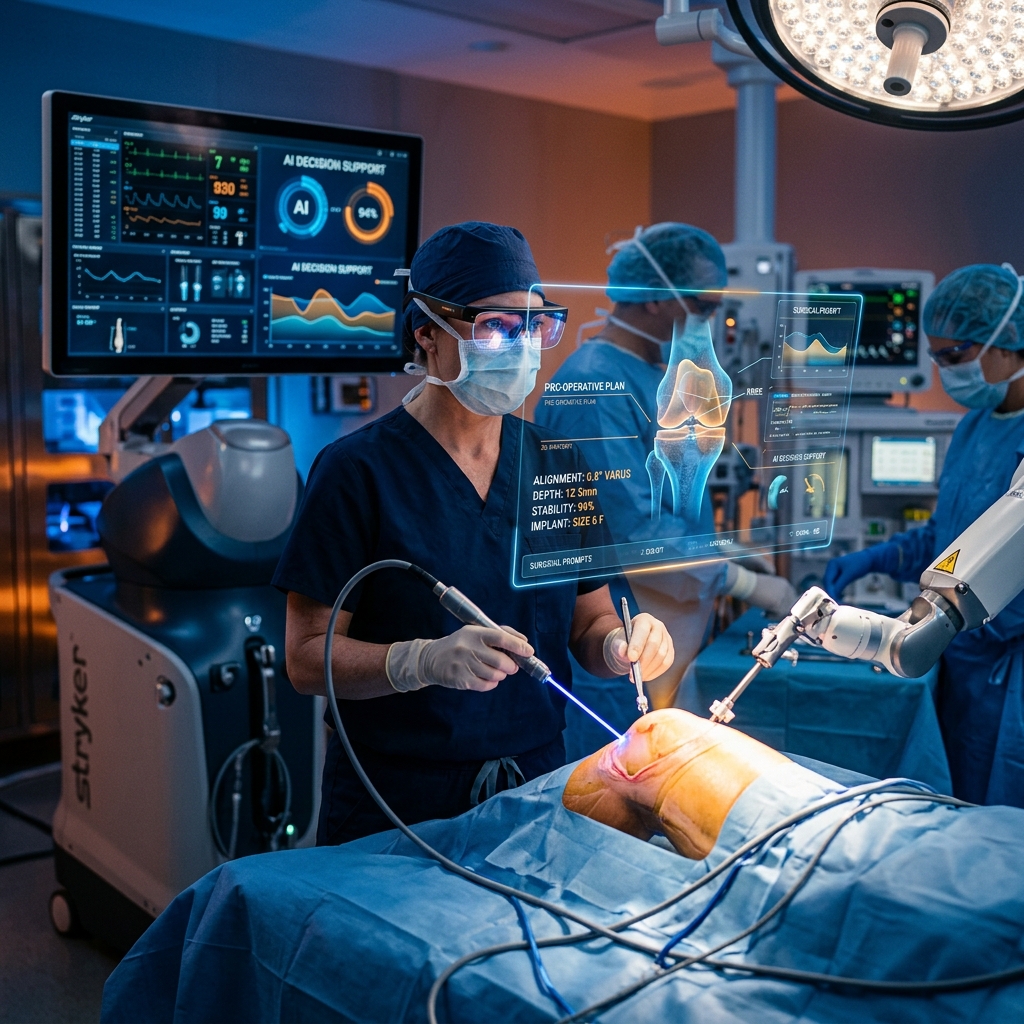
This precision in pre-operative planning directly benefits procedures like robotic knee arthroplasty, where the robotic system's accuracy is only as good as the plan it executes.
Intraoperative AI: Real-Time Surgical Guidance
AI is beginning to provide real-time decision support during surgery:
Computer Vision for Anatomy Recognition
AI models trained on surgical video can identify anatomical landmarks, tissue types, and instrument positions in real-time, providing overlay guidance and safety alerts during laparoscopic and arthroscopic procedures.
Predictive Blood Loss Monitoring
Machine learning models analyzing vital signs, surgical video, and procedure stage can predict significant blood loss events 10-15 minutes before they occur, allowing proactive intervention.
Post-Operative Prediction: Forecasting Outcomes Before Discharge
Predictive analytics applied to post-operative data are enabling:
- Readmission risk scoring: AI models predict 30-day readmission risk with 85% accuracy, allowing early intervention for high-risk patients.
- Complication detection: Natural language processing of nursing notes and early vitals can flag developing complications 24-48 hours before clinical presentation.
- Recovery trajectory modeling: Machine learning predicts individual patient recovery milestones based on demographic, surgical, and post-operative data.
"AI isn't going to replace surgeons. But surgeons who use AI are going to replace surgeons who don't. The technology is a force multiplier for surgical judgment, not a substitute for it."
- Dr. Prem Ramkumar, Orthopedic Surgeon & AI Researcher, Mass General Brigham
Companies Leading the AI-Ortho Charge
| Company | AI Application | Clinical Focus |
|---|---|---|
| Exactech / Blue Ortho | AI-powered surgical navigation | Total Knee/Hip |
| Zimmer Biomet (mymobility) | Post-op remote monitoring & prediction | Arthroplasty |
| Smith+Nephew (CORI) | AI-assisted intraoperative planning | Total Knee |
| Imagen (acquired) | AI imaging diagnosis | Bone fracture detection |
| Antes AI | Pre-operative templating | TKA/THA sizing |
For orthopedic device companies, effectively communicating AI capabilities requires both clinical credibility and the kind of AIEO-optimized content strategy that ensures surgeons discover these innovations through AI search rather than solely through sales reps.
Building AI-powered surgical tools? MedTech Voice helps companies translate complex AI capabilities into surgeon-trusted content.
Position Your AI Technology →