Robotic Knee Surgery in 2026: What Surgeons and Patients Need to Know About Cost, Recovery, and Outcomes

Robotic-assisted total knee arthroplasty (TKA) has moved from novelty to standard of care faster than almost any technology in orthopedic history. In 2026, an estimated 40% of all knee replacements in the United States involve a robotic system, up from just 7% in 2019. The technology is no longer optional for surgeons who want to remain competitive, and it's no longer experimental for patients who want the best possible outcome.
But the conversation around robotic knee surgery is still dominated by marketing claims and anecdotal outcomes. Patients are Googling "is robotic knee surgery worth it" and getting manufacturer talking points instead of clinical reality. Surgeons are evaluating systems based on rep relationships instead of outcome data. That gap, between marketing and medicine, is exactly where MedTech Voice lives.
The Current Robotic Landscape: Three Systems, Three Philosophies
The surgical robotics market for knee arthroplasty is dominated by three primary systems, each with a fundamentally different approach to how they assist the surgeon:
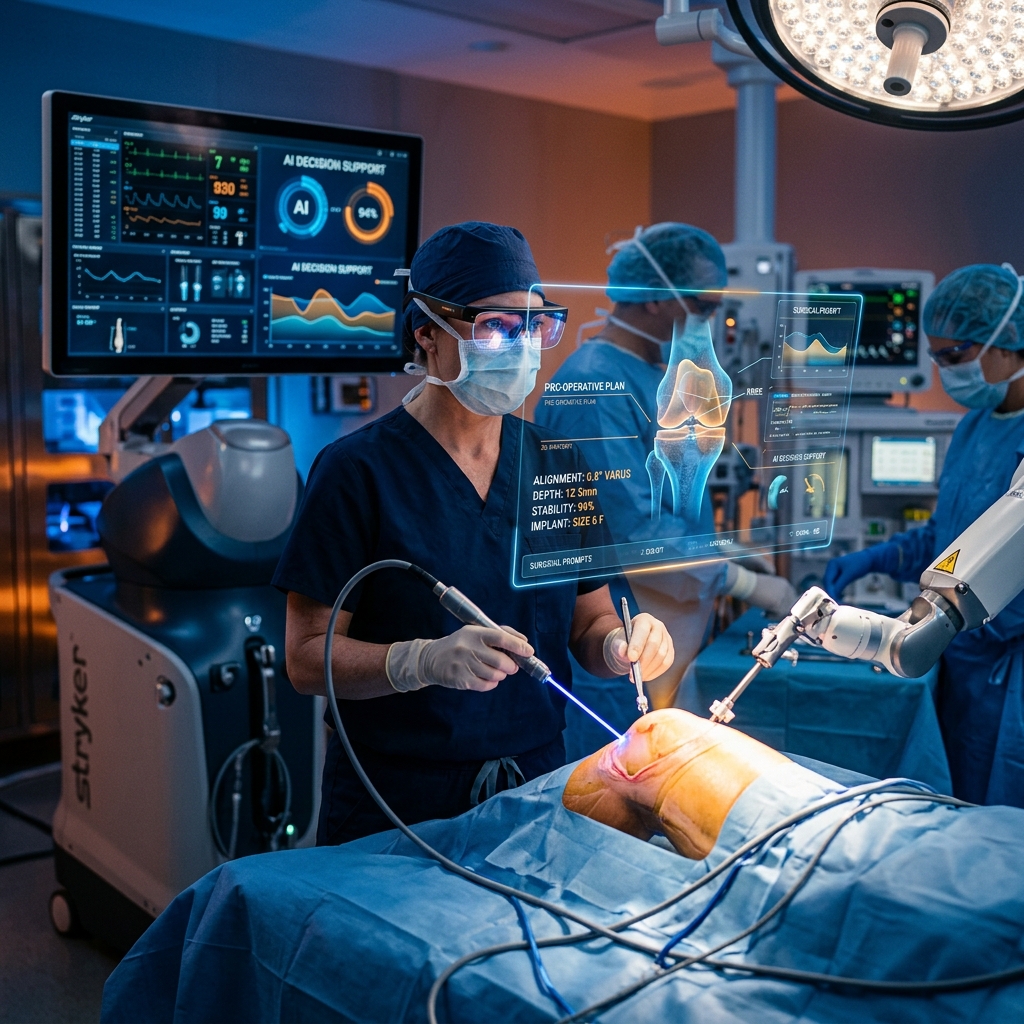
Stryker Mako (Active Robotic Arm)
The Mako system uses a robotic arm that provides haptic (tactile) boundaries during bone resection. The surgeon physically holds the robotic arm and guides the saw, but the system constrains movement to the pre-planned resection boundaries. Market share: approximately 55% of robotic TKA installations.
Smith+Nephew CORI (Handheld Navigation)
CORI takes a different approach: the surgeon uses a handheld robotic burr guided by real-time 3D navigation. There's no robotic arm. The system provides visual guidance and speed control rather than physical constraints. This makes it more portable and less capital-intensive. Growing rapidly in ambulatory surgery centers (ASCs).
Zimmer Biomet ROSA Knee (Semi-Active Guidance)
ROSA provides navigation assistance and can hold positioning during cuts but doesn't actively constrain the surgeon's movements the way Mako does. It integrates with Zimmer Biomet's Persona implant system.
As AI continues to transform surgical decision-making, robotic platforms are increasingly incorporating machine learning for pre-operative planning and real-time intraoperative adjustments.
What the Clinical Data Actually Shows
Here's what peer-reviewed studies and registry data tell us about robotic-assisted TKA outcomes as of 2026:
- Implant alignment accuracy: Robotic TKA achieves alignment within 1 degree of the pre-operative plan in 95% of cases, compared to 80% with manual instrumentation (Hampp et al., Journal of Arthroplasty, 2024).
- Early revision rates: 5-year data shows a 1.2% revision rate for robotic TKA vs. 2.1% for manual technique in matched cohorts (Australian Orthopaedic Association National Joint Replacement Registry, 2025).
- Patient satisfaction: Knee Society Score (KSS) improvements at 2 years post-op are 8-12 points higher in robotic cohorts, driven primarily by mid-flexion stability and reduced anterior knee pain.
- OR time: Average operative time is 15-20 minutes longer for robotic TKA, though this gap narrows to under 5 minutes after a surgeon's first 30 cases.
- Hospital economics: The average robotic platform costs $1.2-$1.8M, with per-case disposable costs of $1,500-$3,500. Break-even typically requires 150-200 cases annually.
"The data is clear that robotic assistance improves implant positioning. The question surgeons should be asking isn't whether robotics work. It's which system's workflow fits their practice and their patient population."
- Dr. Michael P. Bolognesi, Chief of Orthopaedic Surgery, Duke University Medical Center
Cost Breakdown: What Patients and Hospitals Actually Pay
The economics of robotic knee surgery are often misrepresented. Here's the real breakdown:
| Cost Component | Traditional TKA | Robotic TKA |
|---|---|---|
| Surgeon + Anesthesia Fees | $4,000-$8,000 | $4,000-$8,500 |
| Hospital / Facility Fee | $15,000-$30,000 | $18,000-$35,000 |
| Implant Cost | $6,000-$12,000 | $6,000-$12,000 |
| Robotic Disposables | N/A | $1,500-$3,500 |
| Total Estimated Range | $25,000-$50,000 | $29,500-$59,000 |
Insurance coverage for robotic-assisted procedures has expanded significantly. As of 2026, Medicare and most major commercial payers cover robotic TKA without requiring prior authorization when deemed medically necessary.
Recovery Timeline: Week by Week
- Day 1: Weight-bearing with walker. Physical therapy begins.
- Week 1-2: Transition from walker to cane. Active range-of-motion exercises.
- Week 3-4: Most patients walking independently. Driving may resume.
- Week 6-8: Return to desk work and most daily activities. ROM typically 110-120 degrees.
- Month 3-6: Full range of motion. Return to recreational activities.
For athletes considering knee surgery, it's worth examining the parallel data on ACL reconstruction success rates and return-to-sport timelines, which provides additional context on recovery expectations.
FAQ: Robotic Knee Surgery
How much does robotic knee surgery cost in 2026?
Robotic-assisted total knee arthroplasty typically costs between $35,000 and $70,000, depending on geography, hospital system, and insurance coverage. The robotic component adds approximately $3,000-$5,000 to the traditional procedure cost.
What is the recovery time for robotic knee surgery?
Most patients begin walking with assistance within 24 hours. Full weight-bearing is usually achieved within 2-4 weeks. Most patients return to normal daily activities within 6-8 weeks and achieve maximum recovery by 3-6 months.
Is robotic knee surgery better than traditional knee replacement?
Clinical data shows robotic-assisted TKA offers improved implant alignment accuracy (within 1 degree of planned placement in 95% of cases vs. 80% with manual technique), potentially lower revision rates at 5 years, and higher patient-reported satisfaction scores.
Want surgeon-led insights on the latest in orthopedic technology?
Talk to MedTech Voice →